New partnership makes healthspan a core city-design metric alongside connectivity and mobility, with a documented $38 trillion economic opportunity at stake.
LAS VEGAS, NV, UNITED STATES, July 8, 2026 /EINPresswire.com/ — Human Longevity Global (HLG) and the Smart Cities Council (SCC) today announced a global partnership to advance healthspan as a measurable standard for city, government, and organizational design.
At the center of the collaboration is HLG’s proprietary Healthspan Index™, an integrated measurement system designed to evaluate the conditions that build or erode human capacity over time, and the Healthspan Scorecard, its assessment and reporting tool for governments, cities, and organizations.
Through the partnership, the Smart Cities Council becomes the first global smart cities organization to integrate the Healthspan Index™ into its broader urban readiness and development ecosystem. The collaboration marks a significant evolution in how smart communities are defined: moving beyond measuring infrastructure performance alone to assessing the vitality, resilience, and capacity of the people living within them.
For the first time, healthspan can sit alongside mobility, connectivity, energy efficiency, sustainability, and economic performance as a measurable consideration in the design, evaluation, and improvement of communities.
By the numbers:
$5.3 trillion — U.S. healthcare spending in 2024, equal to approximately $15,474 per person and 18% of GDP, with spending projected to exceed 20% of GDP by 2034
$38 trillion — the estimated economic value to the United States of adding just one healthy year to average life expectancy, according to research published in Nature Aging
10+ years — the gap, in many countries, between lifespan and healthspan: years often spent managing chronic illness, cognitive decline, and loss of functional independence
The Gap Driving the Partnership
Over the past century, humanity achieved one of its greatest successes: we dramatically extended lifespans.
But the years lived in good health, cognitive clarity, physical vitality, and meaningful independence have not kept pace.
The result is a growing gap between lifespan and healthspan. In many countries, that gap now exceeds a decade. Its cost is not a distant demographic problem. It is already being absorbed through rising healthcare expenditures, workforce disruption, lost productivity, caregiver burden, and the growing cost of managing chronic disease.
Most systems still measure the consequences of declining health after they appear. The Healthspan Index™ was developed to help leaders see and act on the conditions shaping those outcomes much earlier.
Economists Andrew J. Scott, Martin Ellison, and David A. Sinclair, writing in Nature Aging in 2021, estimated that adding just one year of healthy life expectancy to the U.S. population would create $38 trillion in economic value.
The implication is profound: extending healthspan is not only a healthcare opportunity. It is an economic, infrastructure, workforce, and human-capacity opportunity.
“We have built extraordinarily efficient cities. The question this partnership asks is simpler, and long overdue: are the people living inside them actually thriving? Healthspan gives us a way to measure that. And once it is measurable, we can begin to design for it.” – Dr. Melissa Grill-Petersen, Founder, Human Longevity Global
A New Measurement Architecture For Human Capacity
The Healthspan Index™ is built on a simple premise: human health is not produced by healthcare alone.
The environments people inhabit, the systems they depend upon, and the daily experiences those systems create all become inputs into human biology.
Air quality affects inflammatory burden. Light and noise environments influence circadian regulation and sleep. Food systems shape metabolic health. Mobility and built environments influence daily movement. Housing, social infrastructure, digital access, and community connection affect stress, resilience, participation, and long-term health outcomes.
The Healthspan Index™ brings these previously fragmented variables into one integrated measurement architecture.
It evaluates the relationship between three interconnected domains:
People — biological vitality, physical function, cognitive and emotional resilience, social connection, and the population-level indicators that reflect how well people are living
Planet — the environmental conditions that interact continuously with human biology, including air, water, light, noise, nature access, thermal conditions, and the broader exposome
Systems — the structures that shape daily life, including mobility, housing, food access, preventive health infrastructure, digital access, workplace design, and civic systems
Within those domains, the Index examines the everyday conditions that strengthen or deplete human capacity, including nourishment, movement, rest and circadian rhythm, mental and cognitive resilience, belonging, environmental health, access to preventive care, and health equity.
Unlike a traditional health ranking, the Healthspan Index™ is not designed simply to describe disease prevalence or life expectancy after the fact. It is designed to help leaders understand the upstream conditions that contribute to those outcomes, establish a measurable baseline, identify the greatest opportunities, and track change over time.
From Index to action: the Healthspan Scorecard
The Healthspan Scorecard translates the Index into a clear assessment and decision-support tool for cities, governments, and organizations.
The Scorecard establishes a standardized baseline across the People, Planet, and Systems domains and identifies areas of strength, emerging risks, and opportunities. Results can be viewed as an overall Healthspan Index score and across individual performance dimensions, allowing leaders to see where human capacity is being supported and where targeted intervention may have the greatest value.
The Scorecard is designed to support repeated measurement, benchmarking, and continuous improvement rather than a one-time ranking.
This creates a practical feedback loop:
Measure the conditions. Identify the gaps. Prioritize the levers. Act. Reassess. Improve.
The larger objective is not simply to create healthier cities. It is to give leaders a common language and measurable framework for understanding how decisions across infrastructure, policy, technology, environment, and community design ultimately affect the capacity of human beings to live, work, contribute, and thrive.
“For decades, the smart cities movement prioritized operational and economic efficiency, connectivity, and digital infrastructure over the people and places they were built to serve. ‘Human-centric’ was a buzzword no one could define or measure.
Our partnership with Human Longevity Global, including the formal adoption of the Healthspan Index™ as the default global standard for human wellbeing, is the necessary next step in the evolution of smart cities. By making healthspan a foundational performance indicator for thriving communities, we’re giving policymakers worldwide the insight and the tools to build genuinely intelligent, resilient, human-centered places.” – Corey Gray, Chair & President, Smart Cities Council
Partnership roadmap
The collaboration begins immediately and includes:
Healthspan Index and Scorecard Integration — development of standardized assessment criteria and integration pathways for cities, governments, and organizations
Pilot City Programs — real-world implementation and assessment with participating cities and communities
Organizational Readiness Assessments — structured evaluation of whether governments and executive teams have the strategy, governance, capability, infrastructure, and measurement systems required to improve healthspan outcomes
Advisory and Certification Pathways — strategic support for organizations seeking to translate assessment findings into measurable action and long-term improvement
Global Thought Leadership Series — a co-published international series advancing the conversation around healthspan, urban design, economic resilience, and human capacity, building toward the World Economic Forum at Davos in 2027
Introduction to Healthspan Program — an on-demand educational program through the Smart Cities Council Academy for policymakers, urban planners, infrastructure leaders, and other decision-makers
The first phase of the partnership is now underway, with development of the integrated assessment methodology and pilot implementation strategy in progress.
Broadcast-quality photography, video, executive interviews, and additional background materials are available upon request.
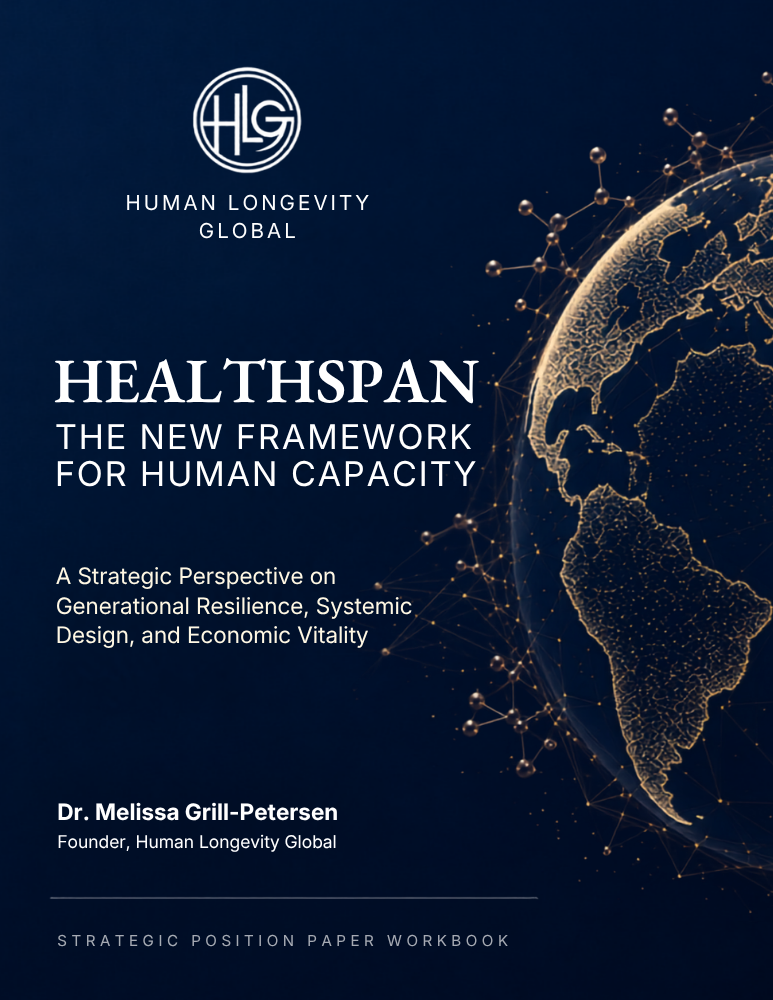
To download the strategic position paper, Healthspan: The New Framework for Human Capacity, or to inquire about pilot programs, advisory services, and certification pathways, visit https://humanlongevityglobal.com/healthspan-index
About Human Longevity Global
Human Longevity Global is a global advisory and consultancy working at the intersection of longevity science, systems design, and human flourishing. Founded by Dr. Melissa Grill-Petersen, HLG develops measurement frameworks, education, advisory strategies, and systemic solutions that help leaders across government, healthcare, urban development, and business design for human vitality, extend healthspan, and build a more resilient longevity economy.
About Smart Cities Council
The Smart Cities Council is the world’s largest and longest-running network of smart city practitioners, policy leaders, technology innovators, and infrastructure developers. Operating across multiple global chapters, SCC works with governments, businesses, and communities to advance livability, workability, sustainability, and responsible urban transformation.
Melissa G Petersen
Human Longevity Global
+1 888-887-5695
email us here
Visit us on social media:
LinkedIn
Instagram
YouTube
Human Longevity Global + Smart Cities Council Deliver the Healthspan Scorecard
Legal Disclaimer:
EIN Presswire provides this news content “as is” without warranty of any kind. We do not accept any responsibility or liability
for the accuracy, content, images, videos, licenses, completeness, legality, or reliability of the information contained in this
article. If you have any complaints or copyright issues related to this article, kindly contact the author above.

Media gallery