
Umeå, Sweden, Oct. 22, 2026 (GLOBE NEWSWIRE) —
- European farmers are facing unprecedented conditions, with rainfall falling far below required levels during planting season and heatwaves reaching damaging heights ahead of harvests.
- While there has been huge investment in climate solutions, including in cover crops, crop rotation and more resilient breeds, these mitigation measures are struggling to handle new extremes.
- Farmers are now looking for the next wave of solutions to help them cope with the ‘new norm’ and balance rising fertiliser costs.
- New independent trial data from the 2025/26 winter wheat season shows Arginex, a seed-applied crop nutrition that activates the root zone, delivers three things that growers need: higher yields driven by faster establishment, yield stability and grain quality.
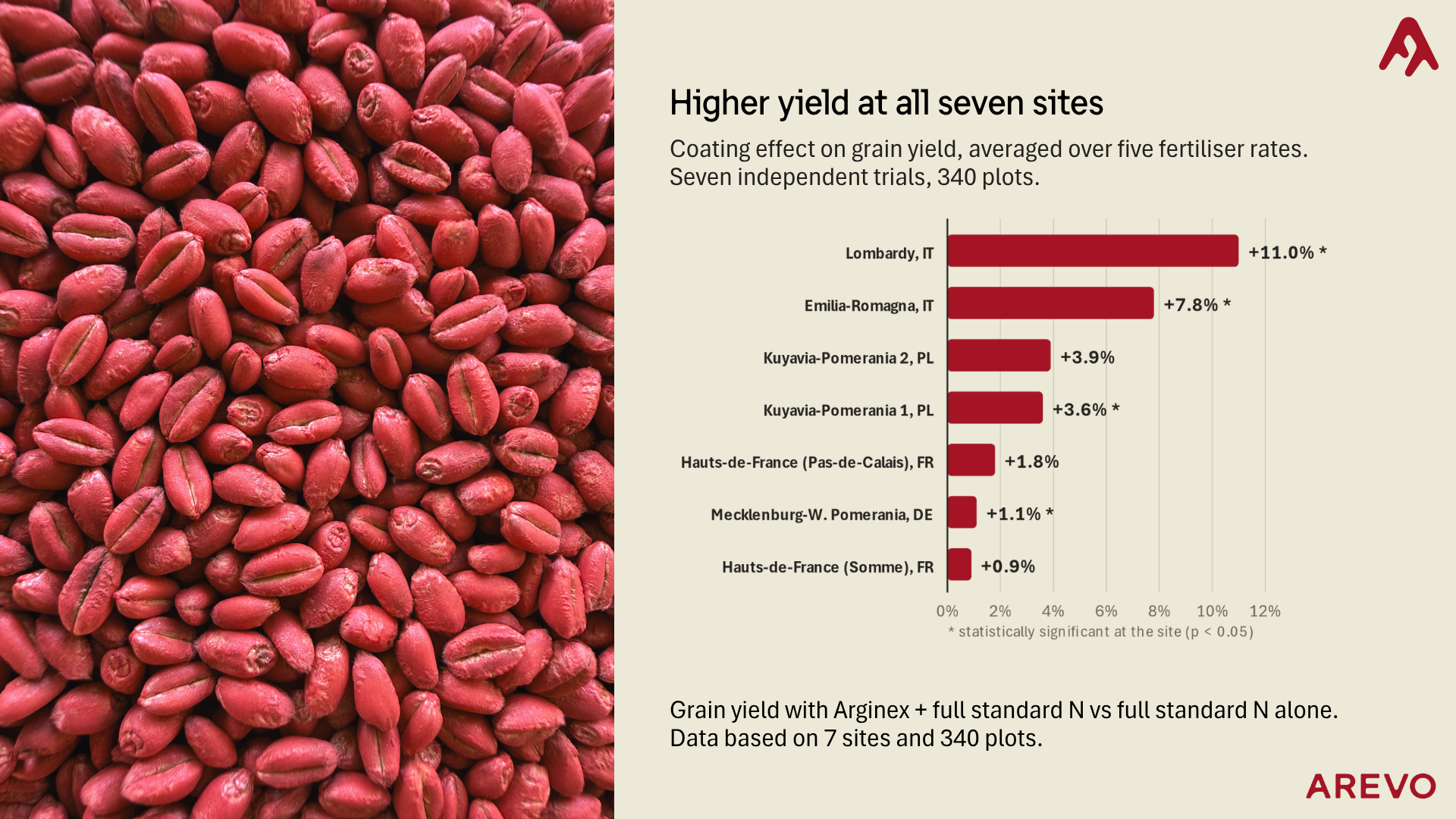
Arginex Wheat: Higher yields at all seven sites
European farmers are facing incredibly challenging growing conditions. Rainfall across winter wheat planting months in October and November 2025 fell far short of the optimal levels of 150mm to enable germination and seedling establishment1 in key regions. At the same time, temperatures ahead of harvest time in July and August exceeded 40 degrees Celsius in many parts of the continent, when wheat crops start suffering damage and heat stress as ambient daytime temperatures reach just 26 to 27 degrees Celsius2.
But they are not new to climate challenges or mitigation strategies. The continent is the second largest single commercial market for regenerative practices and it’s expanding rapidly3. Farmers have invested heavily in climate mitigation measures including cover crops, crop rotation and more resilient breeds, but these measures are struggling to withstand the extreme conditions. Cover crops and organic surface mulch are proven to reduce soil temperatures by only 2-7 degrees Celsius4 and even heat tolerant plants experience severe cellular degradation when ambient temperatures surpass 40 degrees Celsius5.
Hot, dry weather in May and June struck wheat at flowering and grain fill last season: France’s soft wheat crop was forecast in July at 30.8 million tonnes, with yields 6.5% below the ten-year average, and Germany’s winter wheat harvest is estimated at 10.4% below 2025. Nitrogen, meanwhile, cost EU growers around 71%6 more in April 2026 than the 2024 average, right in the middle of the spring top-dressing window.
Driven by the impact of unpredictable weather and rising fertiliser costs, European farmers are now looking for new solutions that can help them face ‘new normal’ weather conditions. Arginine-based crop nutrition technology is being increasingly proven in trials to activate root zones and deliver stronger crops, healthier soils, and more sustainable harvests. As it is positively charged, it binds to the soil, activating stronger roots with longer hairs, greater surface area and deeper reach – while boosting overall soil health. It also helps reduce the use of mineral fertilisers, lowering these costs and helping to mitigate further climate impacts.
Three results from the 2025/26 wheat season
Arevo’s new wheat data comes from replicated field trials run by an independent contract research organisation at seven sites in northern France, Germany, northern Italy and Poland: 340 plots, each site testing five fertiliser rates with and without Arginex seed coating, in a season when heat and drought cut harvests across Western Europe.
1. Faster establishment, more grain. Winter wheat grown from Arginex-treated seed yielded 0.26 t/ha more on average (a 4.3% gain), showing a statistically significant response across the program (p = 0.009). The technology delivered its strongest impact where crops faced severe environmental stress during establishment, such as drought, sandy soils, and high heat, while providing a more moderate yield insurance effect in near-ideal growing environments. The difference depends on how hard it was for the crop to establish itself. In Germany and France conditions at establishment were close to ideal, and the crop was able to produce seedlings within days, so there was less for the coating to add. In Poland the crop went into sandy soils through a very dry season, and in Italy it faced a hot May and June. Where establishment was hardest, the faster start from Arginex was worth most. The gain held at every fertiliser rate tested: with nitrogen and phosphorus cut by 20%, Arginex-treated wheat was not significantly different from the uncoated crop on the full programme (p = 0.36), while the uncoated crop on the same cut lost 0.43 t/ha.
With 20% less nitrogen and phosphorus, Arginex-treated wheat was not significantly different in yield from the untreated crop on full fertiliser, while the untreated crop on the same cut lost 0.43 t/ha. This is relevant for growers facing nitrogen restrictions.
2. Yield stability. A grower cannot control the weather, or the wetter and drier patches of a field, and these show up as differences in yield between plots that were sown and fertilised identically. In the 2025/26 season, with drought in Poland and a hot May and June in Italy, plots sown with Arginex-treated seed varied about 20% less in yield than plots sown with untreated seed. The treated crop held steadier at all seven sites (p = 0.01).
3. Grain quality. Grain quality held up: changes in grain protein were small (−0.3 to +0.4 percentage points) and thousand-kernel weight was unchanged at six of seven sites, so the extra yield came mainly from more grains.
What drives the gain
- Faster establishment. At both Italian sites coated seed emerged 14 to 18% faster at the first count (p ≤ 0.001) and the early spring canopy was 15 to 29% greener, measured by NDVI (p < 0.001). In Poland, coated plots had 12 to 18% more ground cover in early spring (p < 0.001). Early plant height was 8 to 10% greater at four of the seven sites.
- Grain quality protected. More grain did not mean thinner grain: protein held and kernel weight was unchanged at six of seven sites.
- More even crops. Treated plots varied less in yield than untreated plots at every site. This suggests the coating buffers the crop against the uncontrollable factors that always vary across a field, so a bad patch or a dry spell costs less yield.
Grower-standard fertiliser rates differed between sites, from around 92 kg N/ha in Italy to around 145 kg N/ha in Poland, so a 20% cut saves a different amount of nitrogen at each site.
As well as the trial data, farmers working with Arginex outside the replicated trials reported visible differences at harvest. A Danish grower in the 2026 wheat trials said: “We could see a visible physical difference in stem and straw quality when the wheat was harvested.”
Arginex Wheat works by combining arginine with phosphate in a stable, slow-release complex that plants take up intact, without prior mineralisation. Unlike biostimulants built on living microbes or variable blends, it is a non-microbial formulation, which means it has a long shelf life, is stable on-seed and works with standard seed treatment programmes. The arginine also supports soil biology, attracting mycorrhizal fungi and strengthening root systems for stronger early growth.
“Growers are looking for more than a higher yield. What they want is to hold their yield year after year, even when the unpredictable hits, such as the weather,” said Dr Georgios Foufas, CEO of Arevo. “Arginex-treated seed has shown a clear pattern. Plot-to-plot variation in yield was 20% lower where the seed was coated with Arginex than where it was not. And because the crop establishes faster, it gets extra days in autumn to build the roots and tillers it will carry through winter and turn into grain the following summer.”
“Farming is unpredictable. Arginex is not,” Dr Foufas continued. “A wheat grower commits to a crop in October and finds out how it went the following July. The frost, the drought and a fertiliser price that moves by the week are all out of their hands. What goes on the seed shouldn’t be. Arginex is a single, non-living molecule, identical in every batch. In its first wheat season it added yield at every one of the seven sites, held the crop steadier through the conditions growers can’t control, and did it without trading away protein.”
The wheat results were from 2025/2026 season, and follow-up evaluations are already planned for the next season. These results come shortly after trial results for corn, where Arginex Corn was proven to deliver up to 4.3% more grain yield with 30% less nitrogen fertiliser in independent trials across Europe and South America.
1 https://wikifarmer.com/library/en/article/wheat-irrigation-requirements-and-methods
2 https://pmc.ncbi.nlm.nih.gov/articles/PMC12249304/
3 https://pdf.euro.savills.co.uk/portugal/spotlight-regenerativeargiculture-singlepages-202604.pdf
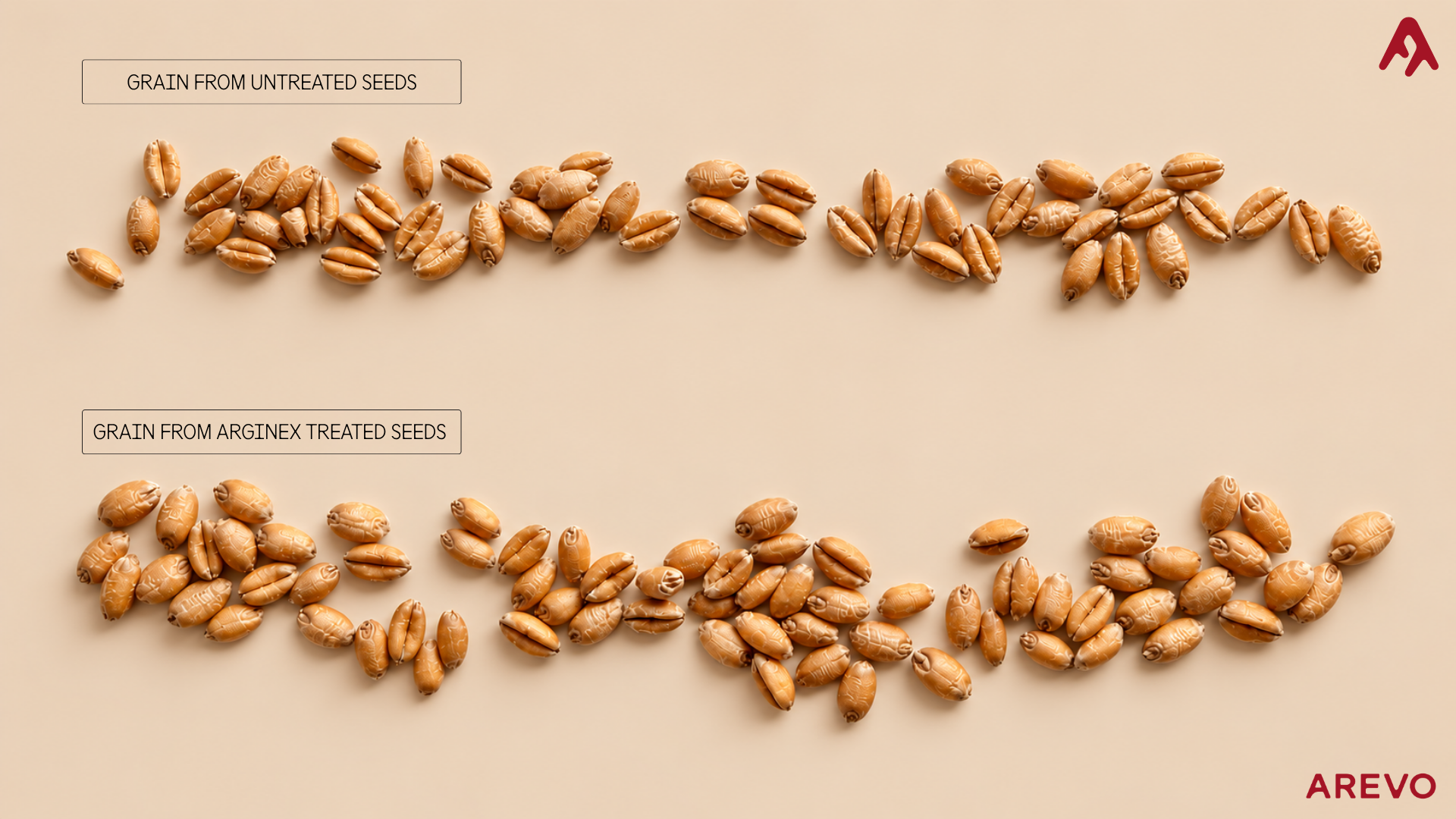
Arginex Wheat: Improved grain quality and held up despite reduction in nitrogen fertilisers
About Arevo
Revolutionizing global agriculture from the ground up. Arevo offers a new alternative to harmful mineral fertilizers: working with biology, not against it. Its proprietary Arginex crop nutrition technology activates the root zone in a way no other product does, resetting the fundamentals of crop nutrition, empowering growers to produce more with less. This isn’t just another input. It’s a catalyst and a movement for systemic change: sparking a chain reaction that makes the whole system stronger and helps growers transition away from harmful chemicals. Rooted in science, and proven in the fields, Arevo stands for redefining agriculture from the ground up.
Press Inquiries
Ling Koay
ling.koay [at] arevo.se
https://arevo.se
Dåva Energiväg 8


