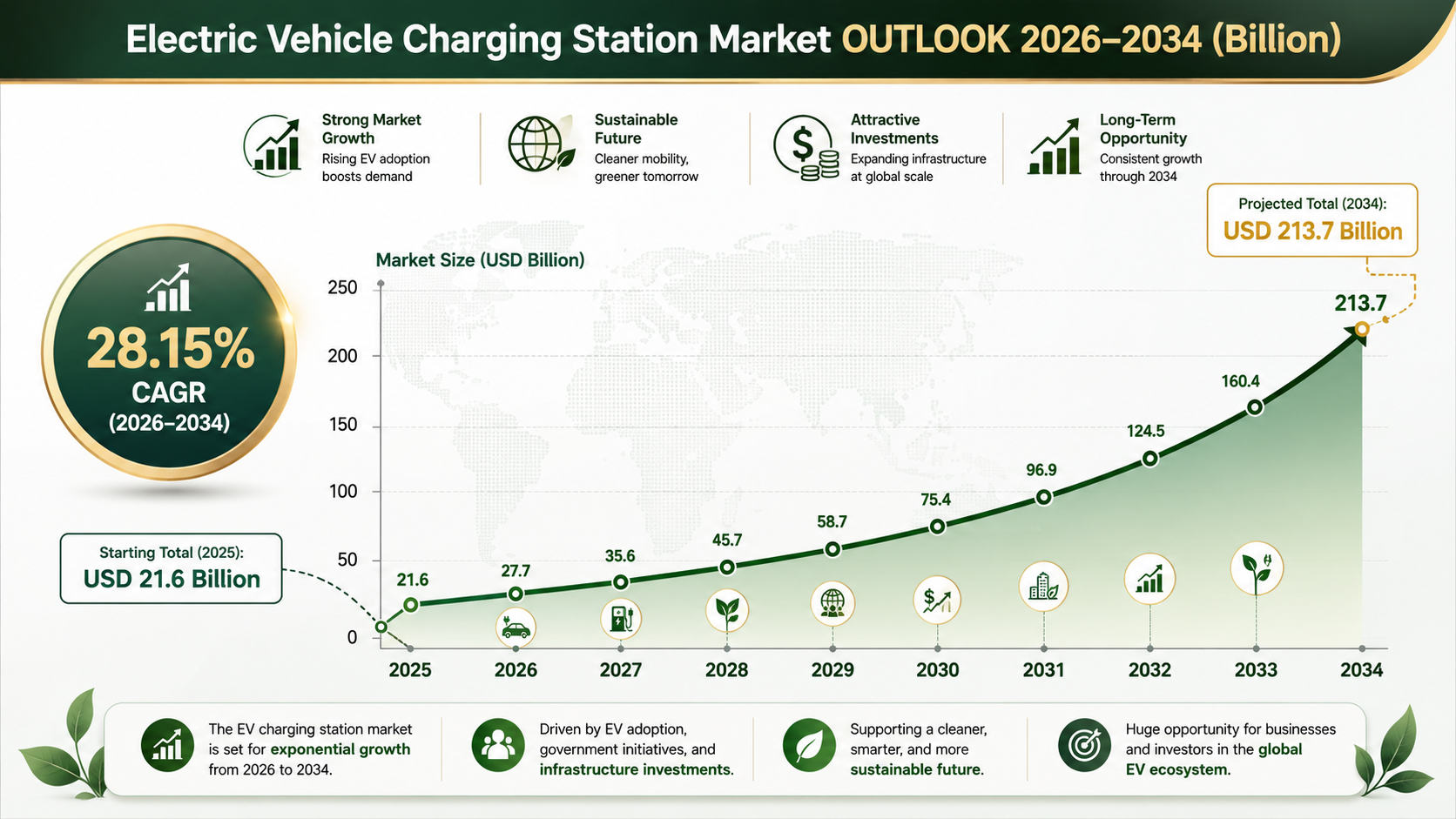
The global electric vehicle charging station market reached USD 21.6 Billion in 2025 and is projected to reach USD 213.7 Billion by 2034.
NEW YORK, NY, UNITED STATES, May 7, 2026 /EINPresswire.com/ — The global EV charging station market reached USD 21.6 Billion in 2025 and is projected to reach USD 213.7 Billion by 2034, expanding at a CAGR of 28.15% during 2026–2034, according to the latest report by IMARC Group. The EV charging industry is now in its most pivotal year yet with the NACS (SAE J3400) standard going mainstream, Tesla pushing toward 40,000 Supercharger ports, and major operators including ChargePoint, BP Pulse, EVgo, and Ionna scaling ultra-fast EV charging networks across North America, Europe, and Asia Pacific.
EV Charging Station Market Report Highlights
• Market Size (2025): USD 21.6 Billion
• Forecast (2034): USD 213.7 Billion
• CAGR (2026–2034): 28.15%
• Leading Region: Asia Pacific (54.5% share)
• Top Charging Type: AC Charging (88.1% share)
• Top Vehicle Type: Battery Electric Vehicles / BEVs (78.8% share)
• Top Application: Residential EV Charging (61.1% share)
• Top Charging Level: Level 2 EV Charging (69.7% share)
• Top Installation: Fixed EV Chargers (93.2% share)
Download a Free Sample of the EV Charging Station Market Report: https://www.imarcgroup.com/electric-vehicle-charging-station-market/requestsample
EV Charging Station Market Outlook 2026–2034
Electric vehicle (EV) charging stations are the backbone of the global transition to electric mobility. As EV adoption accelerates, demand for residential EV charging, commercial EV charging, public DC fast charging corridors, and fleet EV charging infrastructure is rising sharply across every major market.
In 2025, the global EV charging station market reached USD 21.6 Billion. By 2034, IMARC Group expects it to reach USD 213.7 Billion at a 28.15% CAGR one of the fastest growth trajectories in the entire mobility infrastructure sector.
What’s Happening in the EV Charging Industry Right Now (2026)
NACS (SAE J3400) Becomes the De Facto EV Charging Standard
The most consequential shift in EV charging this year is the industry-wide adoption of the North American Charging Standard (NACS / SAE J3400). As of January 2026, NACS accounts for roughly 48% of US DC fast-charging connectors, with CCS1 at 40%. Non-Tesla NACS stalls have surpassed 2,500, with ChargePoint, Ionna, and BP Pulse leading the deployment outside the Tesla Supercharger network. Major automakers including Stellantis have secured Supercharger access across North America, Japan, and South Korea – accelerating the consolidation around a single, faster, more reliable EV charging connector.
Tesla V4 Supercharger Rollout Accelerates Toward 40,000 Ports
With V3 Supercharger production wound down, Tesla is now opening new V4 Supercharger sites every week. The company added approximately 1,200 new Supercharging stalls in Q1 2026 alone and is on track to reach 40,000 ports by year-end. V4 hardware delivers higher peak power, supports non-Tesla EVs natively, and is designed to handle next-generation EVs with larger battery packs and faster charge curves.
Ultra-Fast DC Charging Networks Expand at Record Pace
EVgo, Ionna, Red E, and BP Pulse are scaling DC fast charging deployments at unprecedented speed. EVgo alone has installed 100 new NACS-equipped fast chargers and plans to add over 500 more in 2026. Ionna added 278 new ports in Q1 2026 – the fastest-growing non-Tesla DCFC network. The combined effect: ultra-fast EV charging is moving from a coastal urban convenience to a true national highway capability.
BP Pulse and Simon Property Bring EV Charging to Retail Hubs
BP Pulse continues to build out its Gigahub strategy with Simon Property Group, installing and operating EV charging across 75 Simon retail locations with over 900 fast EV charging stalls planned. The deal exemplifies a broader 2026 trend: EV charging is increasingly being deployed where consumers already spend time shopping malls, hotels, parking garages, and workplaces – rather than purpose-built charging plazas.
AI-Powered and Smart EV Charging Goes Mainstream
Smart EV charging – IoT-connected chargers, AI-driven load balancing, dynamic pricing, and grid-aware scheduling is becoming standard. Operators are deploying machine-learning models to predict demand, route EVs to available stalls, optimize energy costs through time-of-use pricing, and integrate solar and battery storage at charging sites.
Speak with an IMARC Analyst on the EV Charging Station Market: https://www.imarcgroup.com/request?type=report&id=4827&flag=C
EV Charging Station Market Drivers 2026
1. Surging Global EV Adoption
Battery Electric Vehicles (BEVs) account for 78.8% of EV sales in 2025. Rising fuel costs, expanding EV model availability, improved battery performance, and clean-mobility policies continue pushing consumers toward electric vehicles directly driving demand for EV charging stations across residential, commercial, and public segments.
2. Government Policies and Infrastructure Funding
Governments worldwide are funding EV charging infrastructure through purchase subsidies, tax credits, zero-emission mandates, and large-scale public charging grants. The US National Electric Vehicle Infrastructure (NEVI) program, EU Alternative Fuels Infrastructure Regulation (AFIR), and China’s national EV charging targets are deploying tens of billions of dollars into EV charging networks through 2030.
3. Faster EV Charging Technology
Ultra-fast DC chargers (350 kW+), bidirectional EV charging (V2G/V2H), wireless inductive EV charging, and 800V vehicle architectures are dramatically reducing charge times and unlocking new use cases fleet electrification, long-haul trucking, and grid services.
4. Smart Cities and Sustainable Urban Planning
Cities are mandating EV charging readiness in new buildings, parking structures, and residential developments. EV charging infrastructure is now considered essential urban utility on par with water, electricity, and broadband particularly in highly urbanized markets in Europe and Asia Pacific.
EV Charging Station Market Segmentation
By Charging Station Type
• AC Charging 88.1% share (leading)
• DC Charging fastest-growing
• Inductive (Wireless) Charging emerging segment
By Vehicle Type
• Battery Electric Vehicle (BEV) 78.8% share (leading)
• Plug-in Hybrid Electric Vehicle (PHEV)
By Installation Type
• Fixed EV Chargers 93.2% share (leading)
• Portable EV Chargers
By Charging Level
• Level 2 EV Charging 69.7% share (leading)
• Level 3 / DC Fast EV Charging fastest-growing
By Application
• Residential EV Charging 61.1% share (leading)
• Commercial EV Charging
Buy the Full EV Charging Station Market Report: https://www.imarcgroup.com/checkout?id=4827&method=3451
Regional Insights: EV Charging Station Market
Asia Pacific Market Leader (54.5% Share)
Asia Pacific dominates the global EV charging station market with a 54.5% share, led by China’s massive public DC fast charging network, Japan’s CHAdeMO and NACS rollouts, South Korea’s automaker-led charging buildout, and India’s rapidly scaling EV ecosystem. China alone operates the world’s largest public EV charging network.
North America NACS Acceleration
North America is the fastest-shifting region in 2026. Federal NEVI funding, NACS standardization, and aggressive deployment by Tesla, ChargePoint, EVgo, BP Pulse, and Ionna are reshaping highway EV charging. The US EV charging station market alone is projected to grow from USD 3.2 Billion in 2025 to USD 34.2 Billion by 2034 at a 28.60% CAGR.
Europe Decarbonization-Driven Expansion
Europe’s EV charging market is propelled by AFIR mandates, strict CO₂ targets, and renewable energy integration. Western Europe is seeing rapid ultra-fast EV charging deployment along the TEN-T highway corridors.
Key Companies in the EV Charging Station Market
Major players competing in the global EV charging station market include:
• Tesla, Inc. (Supercharger / NACS)
• ChargePoint Holdings, Inc.
• ABB Ltd.
• BP Pulse (BP plc)
• EVgo Inc.
• Ionna LLC
• Shell Recharge Solutions
• Schneider Electric SE
• Siemens AG
• Blink Charging Co.
• Eaton Corporation plc
• Wallbox N.V.
Key Takeaways
• EV charging market projected to grow from USD 21.6B (2025) to USD 213.7B by 2034 at 28.15% CAGR.
• NACS (SAE J3400) is now the dominant DC fast charging standard in North America.
• Tesla on track for 40,000 Supercharger ports by end of 2026.
• Asia Pacific leads with 54.5% share; China remains the largest single market.
• AC charging dominates installations (88.1%) DC fast charging is the fastest-growing segment.
• Residential EV charging leads applications at 61.1% share.
• BP Pulse, EVgo, ChargePoint, and Ionna are aggressively expanding ultra-fast EV charging networks.
• Smart, AI-driven, and bidirectional EV charging is transitioning from pilot to mainstream deployment.
About IMARC Group
IMARC Group is a leading market research company that offers management strategy and market research worldwide. The company partners with clients across all sectors and regions to identify their highest-value opportunities, address their most critical challenges, and transform their businesses. IMARC’s information products cover major market, scientific, economic, and technological developments for business leaders in pharmaceutical, industrial, energy, mobility, and high-technology organizations.
Joy Smith
IMARC Group
+1 631-791-1145
email us here
Legal Disclaimer:
EIN Presswire provides this news content “as is” without warranty of any kind. We do not accept any responsibility or liability
for the accuracy, content, images, videos, licenses, completeness, legality, or reliability of the information contained in this
article. If you have any complaints or copyright issues related to this article, kindly contact the author above.

Media gallery