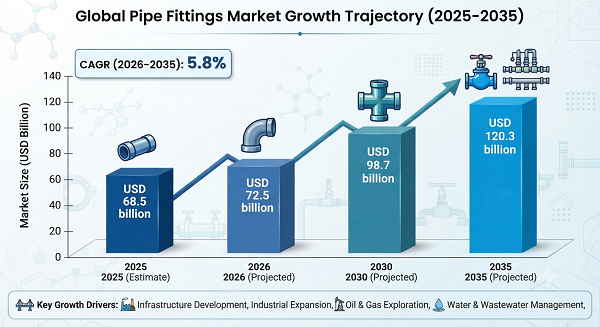
NEW YORK, NY, UNITED STATES, August 27, 2026 /EINPresswire.com/ — The global pipe fittings market is on a robust growth trajectory, with projections indicating it will expand from $68.5 billion in 2025 to $120.3 billion by 2035, reflecting a compound annual growth rate (CAGR) of 5.8%. This significant expansion is driven by accelerating global urbanization and housing construction, massive government water infrastructure mandates (e.g., US Bipartisan Infrastructure Law, India’s Jal Jeevan Mission), aging pipe network replacement cycles in developed nations, and sustained oil & gas midstream expansion.
What are Pipe Fittings?
Pipe fittings are essential components used to connect, terminate, control, and change the direction of piping systems. They are critical for the safe and efficient transport of water, gas, oil, and chemicals. Key material types include:
Plastic (PVC, CPVC, HDPE, PP) (Largest Segment, ~38% share): Dominates due to lower cost, corrosion resistance, and ease of installation, particularly in water distribution and residential construction.
Steel (Carbon & Stainless) : Commands high per-unit value for oil & gas and heavy industrial applications.
Copper: Used in HVAC and medical gas systems.
Major fitting types are Elbows (largest, ~26% share), Tees, Couplings & Unions, and Reducers. Primary end-use sectors are Water & Wastewater (largest, ~31% share), Oil & Gas (fastest-growing, ~6.4% CAGR), and Residential Construction.
Get Sample @ https://www.marketresearchfuture.com/sample_request/26060
Market Drivers: The Forces Behind Growth
Several powerful trends are driving the strong growth of the pipe fittings market:
1. Government Water Infrastructure Mandates (Primary Driver)
Sovereign spending on water infrastructure is the single most predictable demand driver. The US Bipartisan Infrastructure Law allocates $55 billion for water systems, mandating lead service line replacements. India’s Jal Jeevan Mission, targeting 100% rural household tap connections, consumed over 110 million fittings in FY2024 alone. These programs create multi-year procurement visibility unmatched by other end markets.
2. Global Urbanization and Housing Construction
The UN projects 68% of the world’s population will live in urban areas by 2050. Each new urban dwelling requires 35-50 individual fittings. In Southeast Asia, national housing programs target over 10 million new units by 2030. This urbanization directly translates into sustained, high-volume demand for standard pipe fittings.
3. Aging Pipe Network Replacement Cycles
Water distribution networks in Europe and North America, installed between the 1940s and 1970s, are reaching end-of-life. Replacing aging US water mains alone is estimated to cost over $1 trillion. The EU’s revised Drinking Water Directive mandates a 20% leakage reduction by 2030, compelling wholesale fitting replacement. This replacement-driven demand provides a structural floor under the pipe fittings market regardless of new construction cycles.
4. Oil & Gas Midstream Expansion
Midstream pipeline construction, particularly in the Middle East (e.g., Saudi Aramco’s Master Gas System) and the US Permian Basin, generates high-value demand for steel and alloy fittings. These high-pressure applications require premium fittings, commanding longer lead times and higher prices.
5. Industrial and Commercial Construction
The expansion of data centers, pharmaceutical cleanrooms, and manufacturing facilities drives demand for specialized fittings. Prefabricated and modular piping systems, which reduce on-site labor requirements, are gaining traction and positioning the market toward higher-value, engineered solutions.
Market Segmentation: Plastic Leads, Oil & Gas Accelerates
The market is segmented by material type, fitting type, and end-use sector, revealing a dynamic landscape.
By Material Type: Plastic Dominates, Steel Holds Value
Plastic (Largest Segment, ~38% share): Plastic fittings dominate by volume due to their corrosion resistance, light weight, and lower installed cost, particularly for residential construction and municipal water projects.
Steel (High-Value Segment): Steel fittings maintain a critical role with high per-unit value, serving as the standard for oil & gas, chemical processing, and power generation applications.
Copper: A specialized segment concentrated in HVAC, medical gas, and refrigeration systems.
By End-Use Sector: Water & Wastewater Leads, Oil & Gas Surges
Water & Wastewater (Largest Segment, ~31% share): This is the largest end-use segment, underpinned by non-discretionary government spending on potable water and sanitation infrastructure.
Oil & Gas (Fastest-Growing, ~6.4% CAGR): This is the fastest-growing segment, driven by midstream pipeline expansion and LNG terminal construction worldwide.
Buy Now @ https://www.marketresearchfuture.com/checkout?currency=one_user-USD&report_id=26060
Regional Insights: Asia-Pacific Leads, MEA Surges
Asia-Pacific: The Largest and Fastest-Growing Region (~42% share, ~7.2% CAGR)
Asia-Pacific dominates the market, propelled by massive construction activity in China and India. India is the primary growth engine, driven by the Jal Jeevan Mission and Smart Cities Mission. ASEAN nations are also key contributors due to urbanization and FDI-driven manufacturing.
North America: A Major Market Driven by Infrastructure (~22% share)
North America is a significant market, with the United States leading. Growth is anchored by federal infrastructure spending (IIJA), EPA mandates for lead service line replacement, and private-sector activity in the Permian Basin and data center construction.
Europe: A Market Driven by Renovation (~21% share)
Europe’s market is shaped by renovation rather than new construction. The EU Renovation Wave Strategy and the UK’s AMP8 regulatory cycle (committing ~GBP 88 billion to water utilities) drive demand for fittings in network renewal and heating system upgrades.
Middle East & Africa: The Fastest-Growing Region (~6.8% CAGR)
The MEA region is the fastest-growing, driven by Saudi Arabia’s Vision 2030 megaprojects (NEOM, Red Sea) and desalination infrastructure. These projects create demand for high-specification fittings on an unprecedented scale.
Key Players and Competitive Insights
The market is highly fragmented, with regional and local manufacturers dominating volume sales, while multinational engineering firms capture value in specialized sectors.
Georg Fischer (GF Piping Systems) (CH): A leader in premium engineered plastic and metal fitting systems with a focus on digital integration.
Aliaxis (BE): A global polymer specialist with strong presence in Europe and Latin America, recently acquiring Johnson Controls’ CPVC business.
Wavin (Orbia) (NL): Focuses on plastic piping and fitting systems for water management and indoor climate.
Other Key Players: The competitive landscape also includes Mueller Water Products (US), Victaulic (US), Uponor (FI), NIBCO (US), and Reliance Worldwide (RWC) (US).
Recent industry developments include significant acquisitions (Georg Fischer acquiring VAG-Group, Aliaxis acquiring Johnson Controls’ CPVC assets) and a strong focus on innovation, such as push-to-connect fittings and smart, IoT-enabled plumbing systems.
Read More @ https://www.marketresearchfuture.com/reports/pipe-fittings-market-26060
Future Outlook: Smart, Sustainable, and Essential
The pipe fittings market is projected to grow at a steady CAGR of 5.8% through 2035. The future will be defined by the continued convergence of infrastructure investment, digitalization, and sustainability. Key opportunities lie in:
Smart fitting integration and IoT-enabled plumbing systems: Capturing premium pricing by embedding sensors for leak detection and pressure monitoring.
Emerging market water access programs: Tapping into high-volume demand in Sub-Saharan Africa and South Asia.
High-performance composite fittings for extreme environments: Serving offshore oil & gas, desalination, and chemical processing.
Digital transformation and predictive maintenance: Shifting the value proposition from commodity hardware to system-level intelligence and recurring analytics revenue.
As the world invests in resilient water systems, energy infrastructure, and sustainable housing, pipe fittings will remain an essential, high-growth component of the built environment.
Browse More Reports:
Window Film Market https://www.marketresearchfuture.com/reports/window-film-market-11875
metallurgical coke market https://www.marketresearchfuture.com/reports/metallurgical-coke-market-23227
iron ore pellet market https://www.marketresearchfuture.com/reports/iron-ore-pellet-market-22901
bio based coating market https://www.marketresearchfuture.com/reports/bio-based-coating-market-29057
Coil Coating Market https://www.marketresearchfuture.com/reports/coil-coating-market-2395
melt spun fibres market https://www.marketresearchfuture.com/reports/melt-spun-fibres-market-39261
polymer modified bitumen market https://www.marketresearchfuture.com/reports/polymer-modified-bitumen-market-27280
Market Research Future
Market Research Future
+1 855-661-4441
email us here
Legal Disclaimer:
EIN Presswire provides this news content “as is” without warranty of any kind. We do not accept any responsibility or liability
for the accuracy, content, images, videos, licenses, completeness, legality, or reliability of the information contained in this
article. If you have any complaints or copyright issues related to this article, kindly contact the author above.

Media gallery