
Americans are feeling more confident about retirement than they did a year ago, but many remain caught between long-term savings goals and mounting day-to-day financial demands, according to new findings from the 2026 MFS Global Retirement Survey.
This press release features multimedia. View the full release here: https://www.businesswire.com/news/home/20261021489497/en/
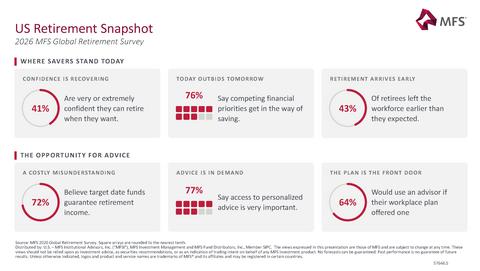
The survey found that 41% of US workplace retirement plan participants are now very or extremely confident they will be able to retire at the age they want, up 13 percentage points from 2025 and the highest level reported in recent years. Yet nearly three-quarters say they will need to save more than planned, while 60% expect to work longer than planned. At the same time, 75% say competing financial priorities prevent them from saving adequately for retirement. Beneath that improvement in confidence lies a more complex reality: inflation, housing costs, emergency savings needs, and other competing financial priorities continue to make retirement planning difficult for many Americans.
“Retirement confidence is encouraging, but confidence alone does not guarantee retirement readiness,” said Jeri Savage, Lead Retirement Strategist at MFS. “Many participants feel more optimistic about their futures, yet they continue to face difficult financial decisions that can affect their ability to achieve their retirement goals. The challenge today is helping people balance immediate financial realities with long-term retirement needs.”
Financial Pressures Continue to Shape Retirement Outcomes
While inflation remains the leading financial concern across generations, participants report a wide range of competing priorities that make saving for retirement more difficult. Three-quarters of respondents say other financial obligations prevent them from saving adequately for retirement, highlighting the increasingly complex financial decisions workers face throughout their lives.
The impact is especially pronounced among younger workers. Gen Z participants are more likely to cite day-to-day financial obligations and emergency savings needs as obstacles to retirement saving, while Gen X participants report greater concern about housing costs. Baby boomers are increasingly focused on healthcare expenses and retirement preparedness.
These findings suggest that retirement readiness is influenced not only by retirement savings behavior, but also by an individual’s broader financial situation and life stage.
Retirement Challenges Become Increasingly Personal
The survey found notable differences in confidence, priorities, and behaviors across demographic groups, underscoring the increasingly personal nature of retirement planning. Millennials reported the highest level of retirement confidence, while Gen X participants remained the least confident generation despite showing improvement from the prior year.
The findings also revealed continuing disparities between men and women. Men reported substantially higher confidence in their ability to retire at their desired age, while women were more likely to prioritize emergency savings and less likely to review their retirement plan investment elections.
Career interruptions also continue to influence retirement outcomes. More than one-third of women reported taking time away from the workforce, compared with roughly one-quarter of men. Women were significantly more likely to cite caregiving responsibilities, including caring for children and aging family members.
Participants Are Looking for More Than Information
As financial challenges evolve over time, the survey suggests that participants increasingly want guidance tailored to their personal circumstances. Younger workers are seeking help with budgeting, major purchases, and building emergency savings, while older participants are focused on retirement income planning, healthcare costs, and Social Security decisions. Retirement income planning emerged as the most important financial wellness topic overall.
“The findings reinforce that retirement planning is no longer a one-size-fits-all experience,” said Savage. “People’s decisions are shaped by their life stage, family responsibilities, and financial circumstances. As retirement challenges become more individualized, participants need more than information. They need practical guidance that helps them make informed decisions and confidently navigate the financial realities they face today.”
Retirement Readiness Varies by Life Stage and Circumstance
Readiness varies sharply by life stage and circumstance. Millennials reported the highest retirement confidence at 46%, followed by Gen Z at 44% and baby boomers at 42%; Gen X remained least confident at 32%. Although inflation was the leading concern across generations, younger workers were more likely to struggle with daily obligations and emergency savings, while older participants placed greater emphasis on housing, healthcare, and retirement income planning.
Gender gaps also persist: 47% of men were very or extremely confident about retiring at their desired age, compared with 33% of women. Women were more likely to prioritize emergency savings, less likely to review their retirement investments, and more likely to report career interruptions related to caregiving. Across participants, three-quarters said competing obligations prevent them from saving adequately, rising to 85% of Gen Z compared with 50% of baby boomers.
“Retirement planning is increasingly personal, shaped by life stage, family responsibilities, and financial circumstances,” said Savage. “Ultimately, improving retirement outcomes may require more than encouraging participants to save. Plan sponsors and advisers can play an important role by helping participants navigate competing financial priorities, simplifying complex decisions, and connecting them with guidance and advice that evolves with their needs over time.”
About the Survey
The MFS 2026 Global Retirement Survey gathered responses from U.S. retirement plan participants and retirees as part of a global study examining retirement confidence, financial priorities, and retirement planning behavior. To qualify US Participants: actively contributing to a 401(k), 403(b), 457, or 401(a) US Retirees: had a 401(k), 403(b), 457, or 401(a), DB plan, or SEP/Simple IRA.
Audience: Ages 18+ Active workplace retirement plan participants / members in the US: 700 participants, 300 retirees. Methodology: 15-minute online survey conducted by Core Data • MFS not revealed as the sponsor. Fielded: June 4 to August 24, 2026
Cohorts: Gen Z: Ages 18 – 29. Millennials: Ages 30 – 45. Gen X: Ages 46 – 61. Boomers: Ages 62 – 80. Silent Generation: Ages 81+.
About MFS Investment Management
In 1924, MFS launched the first US open-end mutual fund, opening the door to the markets for millions of everyday investors. Today, as a full-service global investment manager serving financial advisors, intermediaries, and institutional clients, MFS still serves a single purpose: to create long-term value for clients by allocating capital responsibly. That takes our powerful investment approach combining collective expertise, thoughtful risk management, and long-term discipline. Supported by our culture of shared values and collaboration, our teams of diverse thinkers actively debate ideas and assess material risks to uncover what we believe are the best investment opportunities in the market. As of September 30, 2026, MFS had approximately US$618.7 billion in assets under management.
The views expressed are those of MFS and are subject to change at any time. These views should not be relied upon as investment advice, as securities recommendations, or as an indication of trading intent on behalf of any MFS investment product. No forecasts can be guaranteed.
Unless otherwise indicated, logos and product and service names are trademarks of MFS and its affiliates and maybe registered in certain countries.
© 2026 MFS Investment Management. All rights reserved.
69613.1
View source version on businesswire.com: https://www.businesswire.com/news/home/20261021489497/en/
Media gallery



